
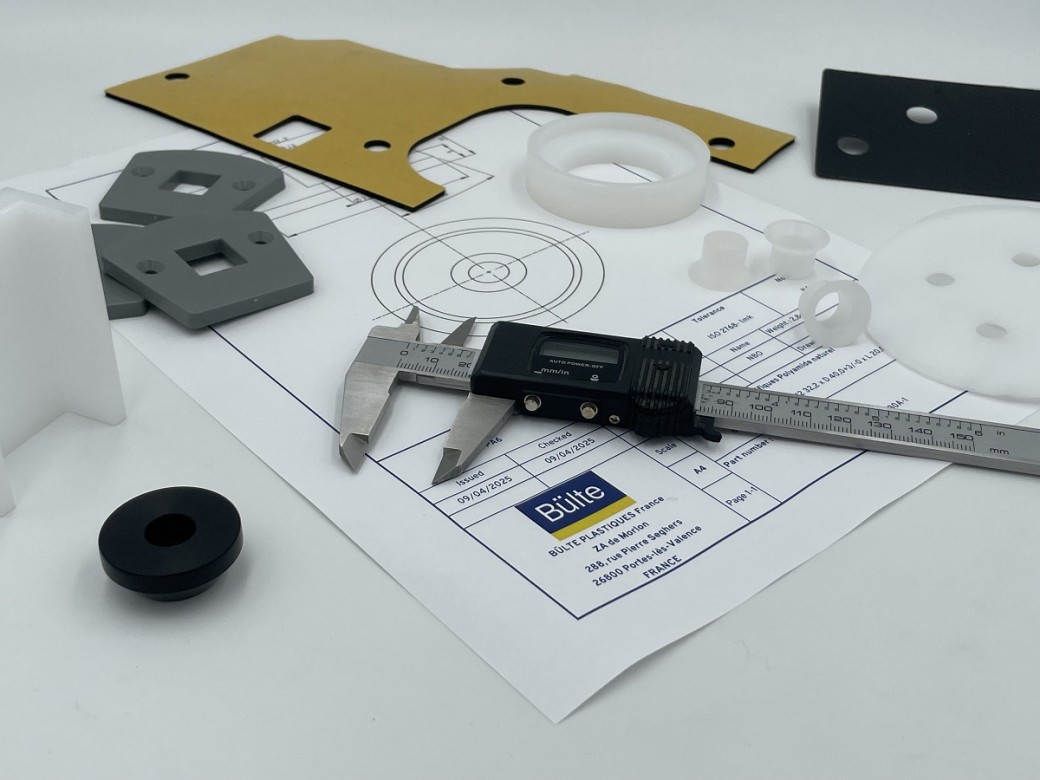
Thermoplastics – Chemical Resistance
Chemical resistance is a key factor when selecting the right thermoplastic. Compare the properties of the most common plastics used by Bülte for plastic fasteners in terms of their resistance to water, acids, alkalis, oils, fuels, solvents and many other substances. This allows you to quickly identify the most suitable material for your application. The information below has been provided by our raw material suppliers.
Key: 1 = resistant • 2 = conditionally resistant • 3 = not resistant
| Material | HDPE | LDPE | PP | Rigid PVC | Flexible PVC | PS | POM | PTFE | PA6 | PC |
|---|---|---|---|---|---|---|---|---|---|---|
| Cold water | 1 | 1 | 1 | 1 | 1 | 1 | 1 | 1 | 1 | 1 |
| Hot water | 1 | N/A | 1 | 2 | 2 | 1 | 1 | 1 | 2 | 2 |
| Water absorption (%) ASTM D 570 |
<0.01 | <0.01 | 0.01–0.03 | 0.04–0.4 | 0.15–0.75 | 0.03–0.1 | 0.22–0.25 | 0.0 | 1.3–1.9 | 0.1–0.2 |
| Weak acids | 1 | 1 | 1 | 1 | 1 | 1 | 2 | 1 | 3 | 1 |
| Strong acids | 1 | 2 | 2 | 1 | 3 | 2 | 3 | 1 | 3 | 2 |
| Oxidising acids | 3 | 3 | 3 | 2 | 3 | 3 | 3 | 1 | 3 | 2 |
| Organic acids | 1 | 1 | 2 | 2 | 2 | 2 | 1 | 1 | 2 | 2 |
| Hydrofluoric acid | 2 | 2 | 2 | 2 | 3 | 2 | 3 | 1 | 3 | 2 |
| Strong alkalis | 1 | 1 | 1 | 1 | 3 | 1 | 1 | 1 | 2 | 3 |
| Weak alkalis | 1 | 1 | 1 | 1 | 1 | 1 | 1 | 1 | 1 | 3 |
| Dry halogens | 3 | 3 | 2 | 2 | 3 | 3 | 3 | 1 | 3 | 1 |
| Aliphatic HC | 1 | 1 | 1 | 1 | 3 | 3 | 1 | 1 | 1 | 1 |
| Aromatic HC | 2 | 3 | 2 | 3 | 3 | 3 | 2 | 1 | 1 | 3 |
| Chlorinated HC | 2 | 3 | 3 | 3 | 3 | 3 | 1 | 1 | 2 | 3 |
| Unsat. chlorinated HC | 3 | 3 | 3 | 3 | 3 | 3 | 1 | 1 | 2 | 3 |
Key: 1 = resistant • 2 = conditionally resistant • 3 = not resistant
| Material | HDPE | LDPE | PP | Rigid PVC | Flexible PVC | PS | POM | PTFE | PA6 | PC |
|---|---|---|---|---|---|---|---|---|---|---|
| Ketones | 1 | 2 | 2 | 3 | 3 | 3 | 2 | 1 | 1 | 2 |
| Ethers | 2 | 3 | 3 | 3 | 3 | 3 | 1 | 1 | 1 | 3 |
| Aldehydes | 2 | N/A | 1 | 3 | 1 | 3 | 2 | 1 | 2 | 3 |
| Amines | 1 | N/A | 1 | 2 | 1 | 1 | 2 | 1 | 1 | 3 |
| Alcohols | 1 | 2 | 1 | 1 | 3 | 1 | 1 | 1 | 1 | 2 |
| Esters | 1 | 2 | 2 | 3 | 3 | 3 | 3 | 1 | 1 | 2 |
| Inorg. salt solutions | 1 | 1 | 1 | 1 | 1 | 1 | 1 | 1 | 1 | 2 |
| Mineral oil | 1 | 2 | 1 | 1 | 2 | 2 | 1 | 1 | 1 | 1 |
| Fuels | 2 | 3 | 2 | 3 | 3 | 3 | 1 | 1 | 1 | 2 |
| Greases, oils | 1 | 2 | 1 | 1 | 2 | 1 | 1 | 1 | 3 | 1 |
| Turpentine | 3 | 3 | 3 | 3 | 3 | 3 | 2 | 1 | 2 | 1 |
Abbreviations: HC = hydrocarbons • inorg. = inorganic • unsat. = unsaturated
Note: The information provided is for general guidance only. It does not constitute guaranteed product characteristics and makes no claim to completeness or accuracy. No liability or warranty is accepted for the information provided. Before use, we recommend verifying the suitability of the respective material for your application by carrying out your own tests. We will be pleased to provide samples for this purpose.
FAQ – Frequently Asked Questions About the Chemical Resistance of Plastics
What does ASTM D570 mean?
ASTM D570 is a standardised test method developed by ASTM International to determine the water absorption of plastics. The measured value indicates how much water a material absorbs under defined test conditions. Low water absorption helps maintain the dimensional stability as well as the mechanical and electrical properties of a plastic, even in humid environments.
Which plastic is resistant to acids?
The level of resistance depends on the type of acid. HDPE, LDPE, PP, rigid PVC, flexible PVC, PS, PTFE and PC are resistant to weak acids. HDPE, rigid PVC and PTFE are suitable for strong acids. PTFE is the only material resistant to oxidising acids and hydrofluoric acid. HDPE, LDPE, POM and PTFE are resistant to organic acids.
Which plastic is resistant to alkalis?
The suitability depends on the type of alkali. HDPE, LDPE, PP, rigid PVC, flexible PVC, PS, POM, PTFE and PA6 are resistant to weak alkalis. HDPE, LDPE, PP, rigid PVC, PS, POM and PTFE are resistant to strong alkalis.
Which plastic is resistant to hydrocarbons?
HDPE, LDPE, PP, rigid PVC, POM, PTFE, PA6 and PC are resistant to aliphatic hydrocarbons. PTFE and PA6 are resistant to aromatic hydrocarbons. POM and PTFE are suitable for chlorinated and unsaturated chlorinated hydrocarbons.
Which plastics are resistant to oils, fuels and greases?
HDPE, PP, rigid PVC, POM, PTFE, PA6 and PC are resistant to mineral oil. HDPE, PP, rigid PVC, PS, POM, PTFE and PC are resistant to greases and oils. POM, PTFE and PA6 are resistant to fuels.
Which plastics are resistant to solvents?
The suitability depends on the type of solvent. HDPE, PTFE and PA6 are resistant to ketones. POM, PTFE and PA6 are resistant to ethers. HDPE, PP, rigid PVC, PS, POM, PTFE and PA6 are resistant to alcohols. HDPE, PTFE and PA6 are resistant to esters.
Which plastics are resistant to water?
The following thermoplastics are resistant to cold water: HDPE, LDPE, PP, rigid PVC, flexible PVC, PS, POM, PTFE, PA6 and PC. HDPE, PP, PS, POM and PTFE are resistant to hot water.
Which plastic has the highest chemical resistance?
PTFE offers the broadest chemical resistance of all thermoplastics compared. It is resistant to weak, strong, oxidising and organic acids, hydrofluoric acid, alkalis, halogens, various hydrocarbons, solvents, oils and fuels, making it particularly suitable for demanding chemical environments.
Which plastics are resistant to dry halogens?
PTFE and PC are resistant to dry halogens.