
Corte por chorro de agua: libertad de diseño para plásticos y elastómeros
En la tecnología de fijación y sellado, los componentes fabricados con precisión y un ajuste óptimo son fundamentales para la funcionalidad, la durabilidad y la seguridad. Especialmente en la producción de elementos de fijación de plástico fabricados con PA, PE, PP, POM o PTFE, así como de juntas y componentes hechos de elastómeros sintéticos como NBR, EPDM o neopreno, el corte por chorro de agua se ha consolidado como un proceso potente y versátil.
¿Cómo funciona el corte por chorro de agua?
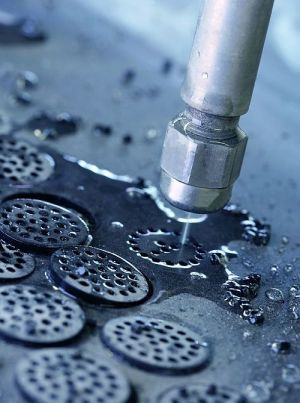
En el corte por chorro de agua, el agua se impulsa a través de una boquilla muy fina a una presión extremadamente alta (> 3.000 bar). El chorro resultante alcanza velocidades de hasta 900 metros por segundo y produce un corte limpio y sin rebabas, incluso en piezas de plástico con radios muy pequeños a partir de 0,04 mm.
Corte por chorro de agua para piezas de plástico: alta precisión y exactitud de contorno
Una ventaja clave del corte por chorro de agua es su proceso sin desgaste, que no requiere herramientas especializadas y, por lo tanto, es resulta altamente rentable. El chorro de agua, constantemente afilado, garantiza una precisión uniformemente alta en toda la producción de piezas de plástico y elementos de fijación. Esto da como resultado bordes de corte extremadamente limpios y prácticamente sin rebabas, ideales para componentes que requieren tolerancias estrictas y que, por lo general, eliminan la necesidad de posprocesamiento.
Proceso de corte en frío para componentes plásticos dimensionalmente estables
Otra gran ventaja es el proceso de corte en frío. A diferencia de los métodos de mecanizado térmico, no se generan zonas afectadas por el calor que puedan alterar las propiedades del material de plásticos técnicos como la poliamida o el POM. Esto garantiza que los elementos de fijación de plástico, juntas y piezas plásticas técnicas mantengan sus propiedades mecánicas y su estabilidad dimensional. Incluso materiales más gruesos o flexibles, como las juntas de neopreno, arandelas de estanqueidad de silicona, NBR o EPDM, permanecen precisos y sin deformaciones.
Piezas de plástico personalizadas – máxima libertad de diseño
El uso directo de datos CAD permite una conversión fluida de las especificaciones de diseño a la producción. Las piezas y elementos de fijación de plástico pueden fabricarse exactamente según plano, mientras que los cambios de geometría pueden implementarse rápidamente y sin costes de utillaje. Esto hace que el corte por chorro de agua sea especialmente adecuado para el desarrollo de productos, la creación de prototipos y la producción de variantes. Dependiendo del tamaño de la boquilla, el radio de corte efectivo suele situarse entre 0,04 y 0,4 mm, lo que permite la producción precisa de elementos de fijación de plástico, arandelas y componentes plásticos personalizados con contornos finos.
El corte por chorro de agua permite formas complejas y geometrías intrincadas
El corte por chorro de agua es ideal tanto para la fabricación de prototipos como para la producción de preseries de componentes plásticos. Las aplicaciones abarcan desde arandelas de plástico hasta piezas personalizadas, incluidos elementos de fijación de plástico con geometrías complejas y piezas de precisión delicadas con paredes delgadas o recortes finos. Las trayectorias de corte optimizadas garantizan un uso eficiente del material en la producción en serie, mientras que los sistemas de corte multicabezal aumentan la productividad en volúmenes mayores de piezas plásticas.
ContáctanosFAQ – Corte por chorro de agua para elementos de fijación y juntas de plástico
¿Cuáles son las ventajas del corte por chorro de agua para elementos de fijación de plástico?
El corte por chorro de agua es un proceso de fabricación altamente preciso y versátil para elementos de fijación de plástico, juntas y otras piezas plásticas técnicas. Las principales ventajas incluyen:
- Alta precisión y exactitud de contorno para componentes plásticos
- Bordes de corte sin rebabas y sin necesidad de posprocesamiento
- Proceso de corte en frío sin estrés térmico en los plásticos
- Sin costes de utillaje y sin desgaste de herramientas
- Ideal para elementos de fijación de plástico complejos y geometrías intrincadas
- Implementación rápida y flexible de diseños CAD
¿Qué plásticos pueden procesarse con la tecnología de chorro de agua?
El corte por chorro de agua es adecuado para una amplia gama de plásticos técnicos, incluyendo poliamida (PA), polietileno (PE), polipropileno (PP), polioximetileno (POM) y politetrafluoroetileno (PTFE). Los materiales elásticos como NBR, EPDM y neopreno también pueden procesarse con alta precisión. Esto hace que el método sea ideal para la producción de elementos de fijación de plástico a medida, elementos de sellado y piezas plásticas técnicas.
¿Por qué el corte por chorro de agua es ideal para elementos de fijación y juntas de plástico?
El proceso es especialmente adecuado para elementos de fijación y juntas de plástico porque:
- No se producen cambios en el material inducidos por el calor
- Los materiales blandos y elásticos mantienen su forma
- Son posibles contornos extremadamente finos y recortes precisos
Esto garantiza un alto nivel de precisión dimensional y una larga vida útil de los componentes plásticos.
¿Qué tan preciso es el corte por chorro de agua para piezas de plástico?
El corte por chorro de agua permite cortes extremadamente finos con radios a partir de aproximadamente 0,04 mm. Esto posibilita la producción de piezas y elementos de fijación de plástico de alta precisión con una calidad constantemente alta, incluso en la producción en serie.
¿Qué geometrías son posibles al cortar piezas de plástico con chorro de agua?
El proceso permite 1) contornos complejos y personalizados, 2) estructuras intrincadas, 3) radios ajustados y recortes finos, y 4) componentes de paredes delgadas. Esto ofrece la máxima libertad de diseño para piezas y elementos de fijación de plástico a medida.
¿Es el corte por chorro de agua adecuado para prototipos y series pequeñas?
Sí, el corte por chorro de agua es ideal para la creación de prototipos, la producción en pequeñas series y la fabricación de elementos de fijación personalizados y otras piezas plásticas. Dado que no se requieren herramientas, los cambios de diseño pueden implementarse de forma rápida y rentable, lo que lo hace perfecto para el desarrollo y la fabricación flexible.